.jpg)
The “once in a lifetime” mirabilite spring mounds are back for the 5th year in a row. They are an extremely rare phenomena that have only been observed in a few places on the entire planet. I find them to be rather fascinating so I generally make it a point to come see them when they are active at least once a year. Plus you know, the Great Salt Lake State Park is kind of a fun adventure anyway.
We thought this would be a good adventure for our bonus day off.

Quick Details:
Length: we did a .43 mile balloon.
Trail Type: Balloon, loop options.
Difficulty: DR3. It is mostly flat, with a small hill. But it is soft beach sand which is a little more tough to walk through.
Elevation Gain: About 75 feet.
Restroom: Flush toilets near the marina and in the Visitor Center (while it is open).
Dogs? Yes, leashed.. However the formations are very delicate. I wouldn’t trust my dogs around them. I would either leave them at home, or if I did have them with us, trade off with my husband about getting a closer look.
Other Info: Fee area: $10.00 per car. Also, good high waterproof boots strongly recommended. My 8" boots have always sufficed.
To Get Here:
Take i80 to exit 104 (west of Salt Lake City). Head north, then turn left at Saltair. Follow the frontage road for about 1.8 miles and you will reach the fee station.

Decker Lake (Passenger Seat Photography (PSP)).

The airport (PSP).

The new art piece (PSP). Once of these days I will manage to get a closer look at it. It is called The Peaks, by artist Gordon Huether. It was unveiled November 2023.
Actually, looking around at the map, I am not sure if there is currently a way to park and/or walk up to it... Guess I will have to see next time I am at the airport.

A herd of antelope (PSP). This is one of the many reasons I am against the stupid “inland port”. I enjoy spotting the wildlife in this area. If they build it all out where is the wildlife going to go?

More (PSP).

A straggler that appears to be trying to catch up to the rest of them (PSP).

Antelope Island (PSP).

The Kennecott smelter stack (PSP). Tallest manmade structure west of the Mississippi.

Saltair III (PSP).

The smelter stack again (PSP).

The Visitor Center (PSP).

We popped into the Visitor Center for a bit. Here is a giant chunk of salt.

The smelter stack again. It's 1215 feet tall! So it certainly stands out. In fact you can see from all the way on the other side of the valley.
The Trail:

The mounds are located on Silver Sands Beach. Accessed just north of the Visitor Center.

Short hill to get down to the beach.

Little jetty viewpoint.

The beach. You want to head directly east.

The smelter stack again.

The mounds ahead. They don’t look like much from here.

In previous years there was a little stream here. I guess it meandered somewhere else.

Footprints.

Antelope Island.

Stansbury Island.
.jpg)
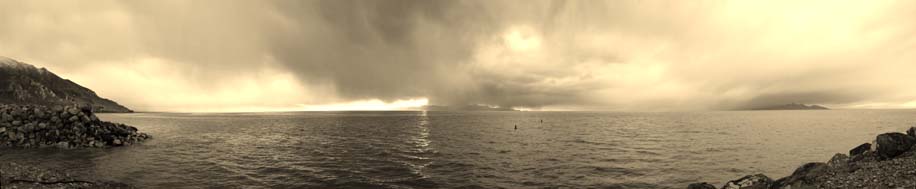
Panoramic.

Saltair III and the mounds.
.jpg)
The mounds. We counted 11.

The big mound. There is always a big one.
From here we decided to go around to the left, clockwise, to see the rest of the mounds.

This mound has dried up and is starting to break down into thernadite.

Another angle.

More mounds.

Smaller one.

The smelter stack above the mounds.

Okay, this one still looks pretty fresh.

Closer.
So a quick explanation as to what is happening here. A couple of feet down there is a layer of a weird salt called Gruber’s Salt. There are some freshwater springs that pull this salt to the surface. When it is cold enough, this particular salt starts to crystalize and starts to build up these terraces.
As I mentioned earlier, once it dries out and starts to warm up, it breaks down to a powder called thernadite, which is really not very interesting. So don’t bother collecting a sample, it won’t last. Not to mention, it is illegal to do so.

Some bigger crystals in the lower mound, and you can see some of the dried out thernadite as well.

The big mound again.
This phenomenon is very rare, and has only been observed in a few places around the entire globe.
The one here were discovered by a park ranger back in 2019. At first it seems awfully convenient that this rare phenomenon showed up within a State Park (like we can control what nature does LOL). But if you think about it, that is likely WHY they were discovered here. Park rangers are more familiar with the area than most people.
They were not expected to come back, but so far have done so every year since. If the lake ever comes back up to the levels before 2019, the mounds will disappear under the water.
I wrote a little more about them in my first post here.

More mounds.

Another one.

A pair of potholes (what I call them). I am still not 100% sure what causes these, but I suspect rocks and moving water from the springs, rain, etc.

I am not sure if this is another spring, or just some of the salt that collected on a little mound of sand.

The big mound, with the Visitor Center and Visitor Platform in the background.

Closer view of the big mound and the terraces.
.jpg)
Panoramic, with a little bit of distortion.

Big crystals.

Closer.

Terraces.


More.

Another pair.

Another pair and the smelter stack.

Down into the crater.

The other one.
I kind of wish I had come a little earlier while they were more active, but again, this has been such a weird dry and warm winter, I am not sure it would have been much better earlier either. In fact I seem to recall they got a late start this year. But when conditions are optimal, man they can be spectacular!

Another spot that I think is just where some salt gathered on raised dirt, rather than another mound.

Small mounds.

More mounds.

Deep footprints. Gotta be mindful in area's like. Stop to take a picture for too long and you start to get sucked in. o.O

Some mounds… and some dumbasses that climbed up on one of them! I don’t normally do this kind of thing, but I did yell at them to get off of it.
Looking back, I guess it’s not really their fault. they probably aren't from around here and in their eyes they saw a random salt mound along the shore of The Great Salt Lake and probably thought it was normal. I wish they would put up signs explaining how fragile and unique the formations are. They only did that the 1st and/or 2nd years. So, sorry randos.

Little mounds next to the big mound.

The big mound and the main cone. It looks like a little volcano.


Flowing terraces.

Colorful puddle.
The big mound.
.jpg)
Panoramic.

Terrace pools and crystals.

More terrace pools.

As usual, the big mound is where it’s at!

We thought about following the beach out to Saltair III today, but decided otherwise.

The big mound.

More terrace pools.

Again.

The big pool.

The west end.

The smelter stack.
.jpg)
One last panoramic of the mounds and the 2 big islands in the background.

Lots of foot prints.

Back across the beach towards the Visitor Center and the Visitor Platform.

Back up the little hill.

The Visitor Platform just to the north.
Well that was a fun little adventure, as always. This mounds were little more lackluster than we have seen, but seriously, this has been a super weird warm and dry winter so not the ideal conditions for them, but they are still neat! It was not super busy as well. 9 squirrels today.

As for difficulty, its mostly flat, with a small hill and a walk along soft beach sand. DR3.

Dogs are allowed, leashed, but I would keep them away from the fragile formations.


No comments:
Post a Comment